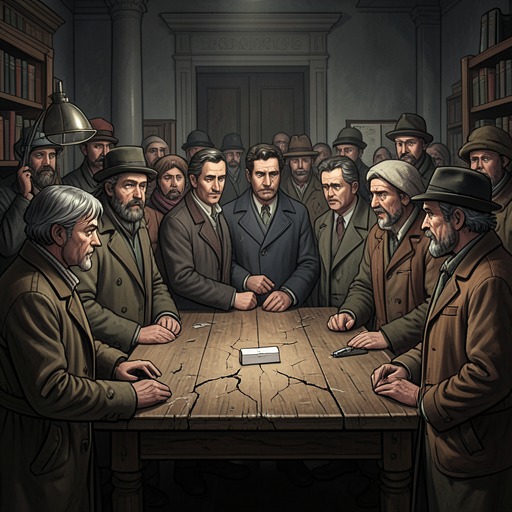
Senator Tassoni
The LeopardSenator Tassoni is a prosperous politician, former comrade of Tancredi Falconeri, and a late bearer of news about Tancredi’s affection for Concetta Salina. When he visits Concetta at the invitation of Angelica Sedàra, he recounts a youthful episode that overturns Concetta’s settled belief that Tancredi had never returned her love. Yet the account does not settle the past: his recollection, Concetta’s response, and Angelica’s contrary assertion expose how fragile the truth becomes when private feeling survives only through memory and report.
Public identity and rise
Tassoni appears as a brisk, spruce old man whose energy seems to defy his years. His considerable and still-growing wealth has come through competition and hard struggle; rather than softening him, it has kept him active and forceful. The military bearing he acquired during a few months with Giuseppe Garibaldi’s southern army remains part of him, blended with a courtesy that helps him persuade and prevail.
His success extends beyond politics into business. Tassoni’s company supplies thread used across half of Italy and much of the Balkan countries, and his holdings give his polished manner practical leverage with the boards of banks and cotton factories. He represents a new kind of power: not inherited grandeur, but energy, commercial reach, and the ability to make personal influence count in formal institutions. His worldly confidence is visible even in how he chooses to sit beside Concetta, selecting a low stool because its humble suitability lets him perform a courtly gesture of homage.
Friendship with Tancredi
Tassoni’s connection to Tancredi Falconeri began in the Risorgimento’s military world and lasted into later life. They were comrades-in-arms, and Tassoni remembers nights camping near the Volturno and around besieged Gaeta when Tancredi spoke of Concetta. The recollections give Tassoni an unusual standing with her: he is not merely a visitor repeating gossip, but someone who knew Tancredi across the years and claims to have heard him speak of her repeatedly.
A decade before his visit, Tassoni had been in Vienna with the Italian delegation negotiating a trade treaty. Tancredi hosted him at the embassy, and they attended the opera, where a performance of Don Giovanni provided the setting for a confession. Tassoni recalls Tancredi describing an evening at Donnafugata when he had invented and told Concetta an outspoken war story connected with the fighting around Palermo. She believed it, took offense, and reproved him. According to Tassoni, Tancredi remembered the incident because her angry response had moved him so deeply that he had struggled to restrain himself from kissing her in front of the company and his uncle.
The visit to Concetta
Angelica arranges Tassoni’s visit to Villa Falconeri, presenting him to Concetta as a close friend of Tancredi and a comrade who has heard him speak of her. She is moved to tears at the mention of her husband. Concetta, however, falls silent when Tassoni’s name is raised: she recalls the old dinner at Donnafugata, with Tancredi’s story, Angelica’s laughter, and her own tears. That memory had marked a turning point in her life, and she has carried its consequences into old age.
Tassoni addresses Concetta with elaborate reverence, calling her the consolation of Tancredi’s youth and saying that Tancredi had spoken of her almost as often as of Angelica. The praise awakens hope before it brings pain. Concetta is initially touched by his warmth and by the thought that this old friend might carry a message across the distance separating the living from the dead. Tassoni’s account then makes her reconsider the rebuke she had long understood as proof of rejection: if he is right, Tancredi’s story had concealed not indifference but an impulse of affection.
Memory, uncertainty, and consequence
The recollection changes Concetta’s interpretation of her life. She had blamed her father’s neglect and regarded herself as wronged; now she fears that her own pride and imprudence helped close the future she had wanted. She remembers Tancredi asking his uncle to let him enter the convent and hears, in retrospect, words of love she had not understood. The possibility that she had mistaken his intentions turns years of resentment into a new and more painful self-accusation.
The narrative nevertheless refuses to certify Tassoni’s version as definitive. Concetta can only wonder whether it is true, and the account stresses how quickly facts in Sicily are altered by imagination and self-interest. In the carriage back to Villa Falconeri, Tassoni worries that his story has hurt her and asks Angelica whether she noticed Concetta’s silence. Angelica answers that Concetta had been madly in love with Tancredi, but that he had never taken notice of her. Her confident correction supplies another version, not a resolution. Tassoni’s disclosure therefore restores a possibility of mutual feeling without recovering an unquestionable past: Concetta is left with the pain of what she cannot verify, while the competing accounts add another layer to the history they seek to explain.
Narrative role
Tassoni is both a figure of the new commercial-political order and a messenger from a vanished personal world. His career shows wealth and influence built through effort, business, and political connections; his friendship with Tancredi gives him access to an intimate history that Concetta herself had never been able to read clearly. The narrative makes that access consequential but not conclusive. He can transmit Tancredi’s remembered words, yet cannot make memory equivalent to certainty, and his well-intentioned intervention leaves Concetta facing both a changed past and the impossibility of proving it.